
Success story
FIGEAC AERO
3D measurement by CMM: 4 times faster inspection at Figeac Aero using Silma and Metrolog X4!
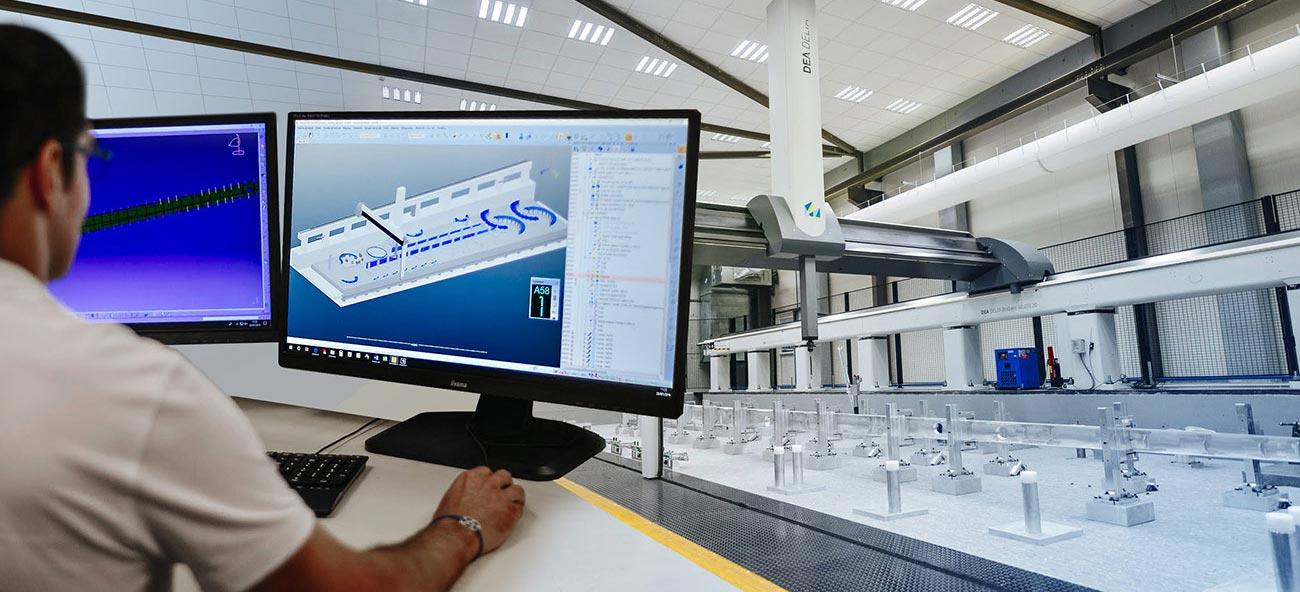

A leader in aeronautical subcontracting, Figeac Aero is involved in almost all ongoing civil aeronautical programs. The company has been continuously growing since it was founded in 1989. With a strategy built around performance and investment into the industrial machinery, it’s no wonder that Figeac Aero keeps one step ahead of the competition.
Quality assurance is a top priority for Figeac Aero, this drive for quality helps differentiate their competitive advantage. The company recently invested in a new three coordinate measurement machine (CMM). The CMM interfaces with Metrolog and Silma X4, Figeac Aero choice for 3D metrology software. As a result, this technological mix led to outstanding improvement of 3D quality inspection within the company. The 3D control team shared their experience on using Silma and Metrolog X4 and insights of this unique application.

At Figeac Aero, top quality leads the way to competitiveness
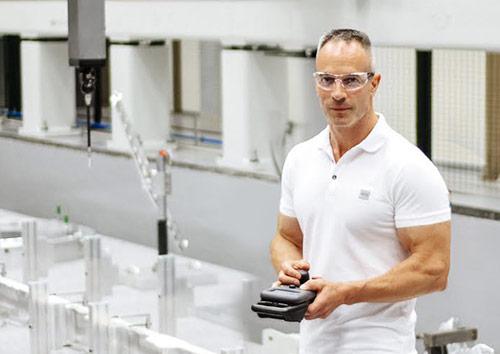
Mr Moncet, manager of 3D control, has been working at Figeac Aero for 19 years. Many of the parts inspected by Mr Moncet’s team include various frame parts such as 10m, 12 m or 14 m long wing spars, reverse thruster frames and beams, manufactured for leading aeronautical companies. According to Mr Moncet, measuring multiple parts is a prerequisite for successful aeronautical subcontracting companies. The ability to work manufacture various assemblies and components enables Figeac to thrive in the competitive aero market.
In addition to managing teams of programmers and quality controllers on a daily basis, Mr Moncet provides his technical expertise for parts quality validation and is in charge of 3D control project management (CMM/ sensors/ 3D measurement software and technology). Mr Moncet is passionate about his career and is a University Professor. He recently orchestrated the integration of one of the largest CMMs.
Metrologic Group is proud to be part of this unique cutting-edge engineering project, with of almost 4 years of investments and technical studies. In order to seamlessly interface with Metrolog and Silma X4, the CMM required a last generation CN. It became possible as a result of collaboration between Figeac Aero, Hexagon and Metrologic Group. “Metrologic Group engineers joined me in Turin when the machine was delivered to verify the integration. The support from Metrologic Group was up to our expectations”, concludes Mr Moncet.
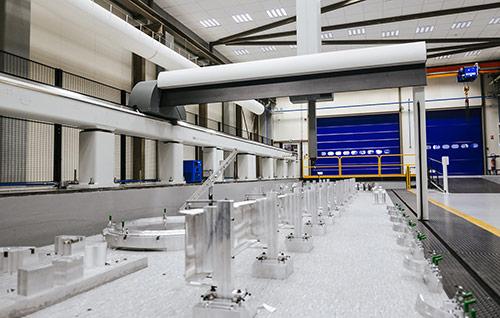
The technological mix, CMM and software, enhanced the efficiency of the 3D inspection team. For instance, in order to measure a 12 m long wing spar, on the previous CMM with a 7 m longitudinal measuring stroke, Figeac Aero 3D control team had to carry out 3D inspection in 2 set-ups and it used to take about 20 hours. Today, the same part can be inspected on the new CMM in one set-up in less than 5 hours!
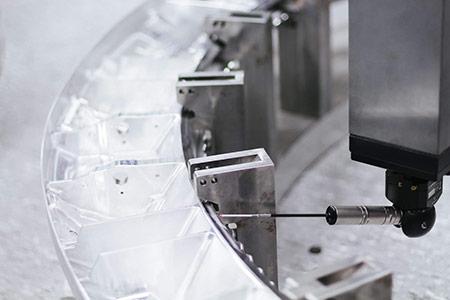
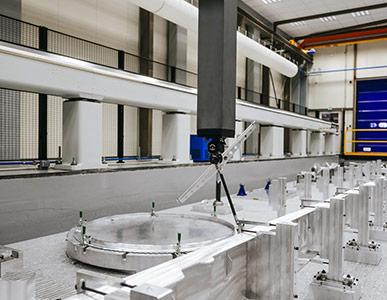
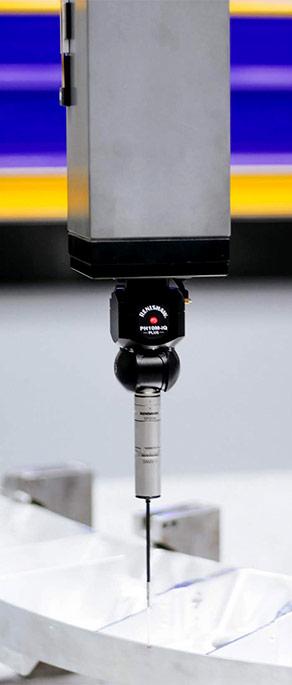
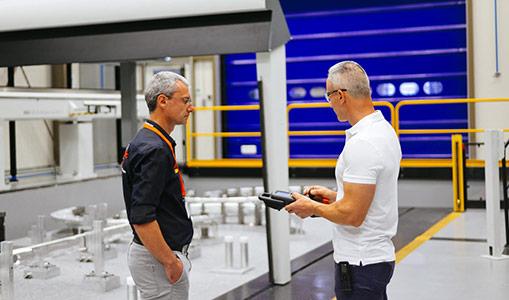
The CMM working with both Silma and Metrolog increases productivity using simulation along with high-level metrology functionalities. As Mr Moncet highlighted “for the inspection of 3D parts of medium and large sizes including frame parts, in particular – our need was oriented towards a very powerful software in surface and geometric measurement. Given the numerous comparisons we make between the real part and the CAD – Metrolog X4 is among the best, if not the best in the market.”
“Metrologic Group has been an historical partner of Figeac Aero: we have been using Metrolog II since 2000, then Metrolog XG and today we have Metrolog X4. When I joined the company, the teams and myself, were trained on Metrolog only. Before Metrolog, Figeac Aero used a very basic software with no access to the virtual definitions of the parts, with lots of manual entry and time-consuming programming. The integration of Metrolog allowed the use of CAD files. Moreover, this brought autonomy to the 3D control department, that was subordinated to the Methods department”, explains Mr Moncet.
.
3D metrology software to help boost the skills

Thierry
3D control engineer for 23 years.
“What I appreciate the most, it is the software capacity to create new programs and validate them entirely in an autonomous fashion. Metrolog X4 is a great solution, we have witnessed the fine evolution of Metrolog from XG to X4 and we continue discovering the power behind this evolving metrology software. I can firmly say that Metrolog enabled me to upskill with regards to my 3D metrology missions.”

Vincent
3D control engineer for 19 years.
“After 15 years of working in machine-tool area, I enjoy the easy-to-use and user friendly side of Metrolog, since I became part of the 3D metrology team. The software allowed me to become quickly autonomous.”

Benjamin
3D & geometrical control for 5 years.
“This new CMM can use both touch and continuous probe. All the tool changes are automatically managed within Metrolog, maximizing machine autonomy. As a matter of fact, the CMM works regularly in an autonomous fashion for at least 8 hours. Therefore, with tools like Metrolog and Silma paired with a 20 meters long CMM, we reached a 98% use rate of the machine – this is a record for Figeac Aero.”

Simulation with Silma X4 for reduced cycle times and increased performance
“Among the advantages of Silma, I would highlight the capability of virtually reproducing the whole inspection environment, including the machine, the head, the probes or the control fixtures. It’s particularly this programming from A to Z of highly complex parts with collision avoidance, that brings us considerable machine time savings and allows to measure more exactly.”
Julien
Offline programming expert with Silma X4.
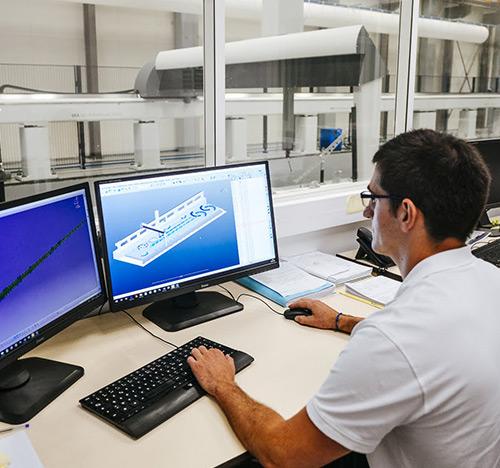

“Silma allows us to carry quite thorough simulations with the digital twin of the measurement environment. While offline programming with Silma, we succeed simulating a comprehensive set of references for greater profitability. The CMM can switch from one part to inspect to another, fully autonomously in hidden time.”
Frédéric Moncet
3D control manager/expert/leader at Figeac-Aero Group
Metrolog X4 – a future-proof software to help upscale 3D measurement at Figeac Aero
The strengths of Metrolog software according to Figeac Aero 3D control team:
- Path optimisation, with assistance for probe definition.
- Easy to use interface, intuitive, all menus are accessible.
- From Mr Moncet “Metrolog was the historical software at Figeac Aero, and therefore tipped the scale, being today the universal standard in our company. All our measuring equipment are interfaced with Metrolog for greater compatibility.” Metrolog has ease of use through the simple layout, intelligent design and intuitive nature.

Challenges
3D measurement at Figeac Aero faces several challenges:
- The clients require the manufacturing of increasingly complex parts
- With tighter tolerances
- At the best price
- To be delivered on time
- With shorter inspection times, but without compromising accuracy

Solutions
- Metrolog X4 – 3D measurement software for on-machine execution
- Silma X4 – offline programming and simulation software
- Value added support during and after the technical study
- Collaboration with Hexagon and Figeac Aero during the interfacing of the CMM to grant optimal functionality.

Benefits
- A winning and sustainable choice with Metrolog/Silma X4 and Hexagon DEA Delta CMM.
- Reduced cycle times, improved efficiency and 3D measurement performance
- Skills improvement for the 3D control team
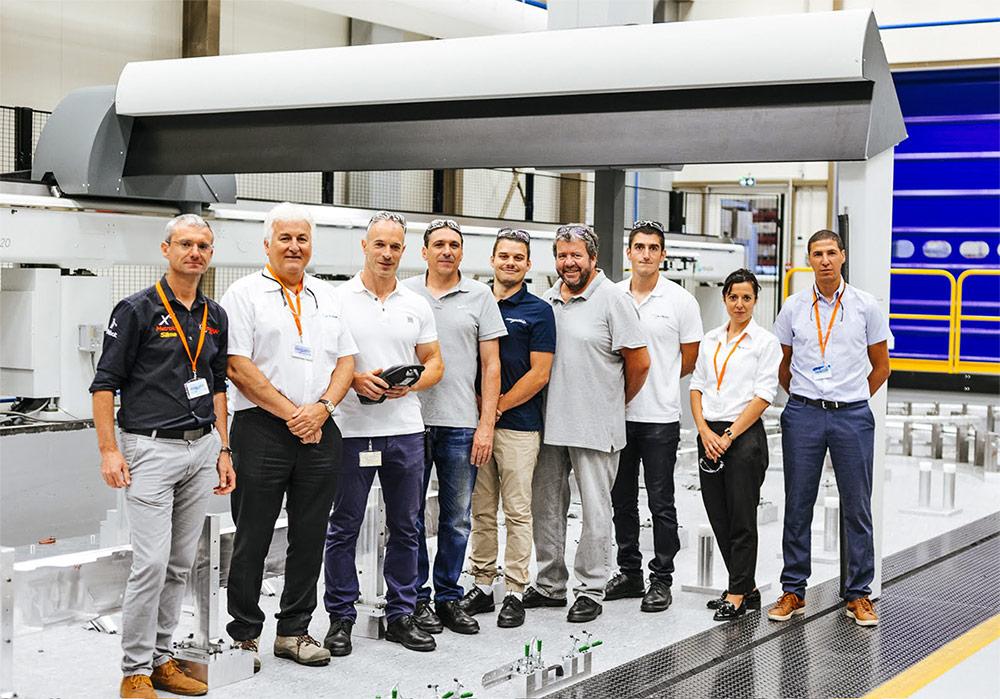
An exceptional project made possible thanks to a successful teamwork (from left to right): Mr Lemoine (Metrologic Group), Mr Jimenez, (Hexagon), Mr Moncet and Figeac Aero 3D quality control team, Mrs Penfield and Mr Tahiri, (Hexagon).
About Figeac Aero
Based in the Lot department in France since 1989, Figeac Aero is the European leader in aeronautical subcontracting. The company specialises in producing light alloy and hard metal structural parts, engine parts, landing gear and sub-assemblies… Among the precision parts or sub-assemblies manufactured for leading aeronautical companies are engine parts for Safran/ General Electric LEAP present on most of the A320 Neo medium-haul aircrafts and all of the 737 Max Boeing and landing gears.
As a key player in its market, Figeac Aero works with all the major aircraft manufacturers (Airbus, Boeing, Snecma, Dassault, Embraer, Gulfstream, Bombardier), engine manufacturers (Rolls Royce, Safran, Pratt & Whitney, GE), and large subassembly makers (Sonaca, Zodiac Aeronautical, Stelia, Latécoère, Triumph Group, Alkan, Daher) and for prestigious programs like A350 and A320.


Download the Case study (Eng)